Appearance
1 FixedThreadPool
1.1 介绍
FixedThreadPool被称为可重用固定线程数的线程池。通过 Executors 类中的相关源代码来看一下相关实现:
java
/**
 * Creates a thread pool that reuses a fixed number of threads
 * operating off a shared unbounded queue, using the provided
 * ThreadFactory to create new threads when needed.  At any point,
 * at most {@code nThreads} threads will be active processing
 * tasks.  If additional tasks are submitted when all threads are
 * active, they will wait in the queue until a thread is
 * available.  If any thread terminates due to a failure during
 * execution prior to shutdown, a new one will take its place if
 * needed to execute subsequent tasks.  The threads in the pool will
 * exist until it is explicitly {@link ExecutorService#shutdown
 * shutdown}.
 *
 * @param nThreads the number of threads in the pool
 * @param threadFactory the factory to use when creating new threads
 * @return the newly created thread pool
 * @throws NullPointerException if threadFactory is null
 * @throws IllegalArgumentException if {@code nThreads <= 0}
 */
public static ExecutorService newFixedThreadPool(int nThreads, ThreadFactory threadFactory) {
    return new ThreadPoolExecutor(nThreads, nThreads,
                                  0L, TimeUnit.MILLISECONDS,
                                  new LinkedBlockingQueue<Runnable>(),
                                  threadFactory);
}另外还有一个FixedThreadPool的实现方法,和上面的类似,所以这里不多做阐述:
java
/**
 * Creates a thread pool that reuses a fixed number of threads
 * operating off a shared unbounded queue.  At any point, at most
 * {@code nThreads} threads will be active processing tasks.
 * If additional tasks are submitted when all threads are active,
 * they will wait in the queue until a thread is available.
 * If any thread terminates due to a failure during execution
 * prior to shutdown, a new one will take its place if needed to
 * execute subsequent tasks.  The threads in the pool will exist
 * until it is explicitly {@link ExecutorService#shutdown shutdown}.
 *
 * @param nThreads the number of threads in the pool
 * @return the newly created thread pool
 * @throws IllegalArgumentException if {@code nThreads <= 0}
 */
public static ExecutorService newFixedThreadPool(int nThreads) {
    return new ThreadPoolExecutor(nThreads, nThreads,
                                  0L, TimeUnit.MILLISECONDS,
                                  new LinkedBlockingQueue<Runnable>());
}
从上面源代码可以看出新创建的 FixedThreadPool 的 corePoolSize 和 maximumPoolSize 都被设置为 nThreads,这个 nThreads 参数是我们使用的时候自己传递的。
1.2 执行任务过程介绍
FixedThreadPool 的 execute() 方法运行示意图(该图片来源:《Java 并发编程的艺术》):
示意图「FixThreadPool的execute()执行示意图」已随上游仓库(DemoTransfer)失效,2026-10 标注%E6%96%B9%E6%B3%95%E8%BF%90%E8%A1%8C%E7%A4%BA%E6%84%8F%E5%9B%BE.png)
上图说明:
* 如果当前运行的线程数小于 corePoolSize,再来新任务就创建新的线程来执行任务; * 当前运行的线程数等于 corePoolSize 后,再来新任务会将任务加入 LinkedBlockingQueue;
- 线程池中的线程执行完 手头的任务后,会在循环中反复从
LinkedBlockingQueue中获取任务来执行;
1.3 为什么不推荐使用FixedThreadPool?
FixedThreadPool 使用无界队列 LinkedBlockingQueue(队列的容量为 Integer.MAX_VALUE)作为线程池的工作队列。这会对线程池带来如下影响:
- 当线程池中的线程数达到
corePoolSize后,新任务将在无界队列中等待。因此线程池中的线程数不会超过corePoolSize; - 由于使用无界队列时
maximumPoolSize将是一个无效参数,因为任务队列不可能满。所以,源码中创建的FixedThreadPool的corePoolSize和maximumPoolSize是同一个值。 - 由于 1 和 2,使用无界队列时
keepAliveTime将是一个无效参数; - 运行中的
FixedThreadPool(未执行shutdown()或shutdownNow())不会拒绝任务。任务多的时候会导致 OOM(内存溢出)。
2 SingleThreadExecutor
2.1 介绍
SingleThreadExecutor是只有一个线程的线程池。下面看看SingleThreadExecutor 的实现:
java
/**
 * Creates an Executor that uses a single worker thread operating
 * off an unbounded queue, and uses the provided ThreadFactory to
 * create a new thread when needed. Unlike the otherwise
 * equivalent {@code newFixedThreadPool(1, threadFactory)} the
 * returned executor is guaranteed not to be reconfigurable to use
 * additional threads.
 *
 * @param threadFactory the factory to use when creating new
 * threads
 *
 * @return the newly created single-threaded Executor
 * @throws NullPointerException if threadFactory is null
 */
public static ExecutorService newSingleThreadExecutor(ThreadFactory threadFactory) {
    return new FinalizableDelegatedExecutorService
        (new ThreadPoolExecutor(1, 1,
                                0L, TimeUnit.MILLISECONDS,
                                new LinkedBlockingQueue<Runnable>(),
                                threadFactory));
}
java
/**
 * Creates an Executor that uses a single worker thread operating
 * off an unbounded queue. (Note however that if this single
 * thread terminates due to a failure during execution prior to
 * shutdown, a new one will take its place if needed to execute
 * subsequent tasks.)  Tasks are guaranteed to execute
 * sequentially, and no more than one task will be active at any
 * given time. Unlike the otherwise equivalent
 * {@code newFixedThreadPool(1)} the returned executor is
 * guaranteed not to be reconfigurable to use additional threads.
 *
 * @return the newly created single-threaded Executor
 */
public static ExecutorService newSingleThreadExecutor() {
    return new FinalizableDelegatedExecutorService
        (new ThreadPoolExecutor(1, 1,
                                0L, TimeUnit.MILLISECONDS,
                                new LinkedBlockingQueue<Runnable>()));
}
从上面源代码可以看出新创建的 SingleThreadExecutor 的 corePoolSize 和 maximumPoolSize 都被设置为 1.其他参数和 FixedThreadPool 相同。
2.2 执行任务过程介绍
SingleThreadExecutor 的运行示意图(该图片来源:《Java 并发编程的艺术》):
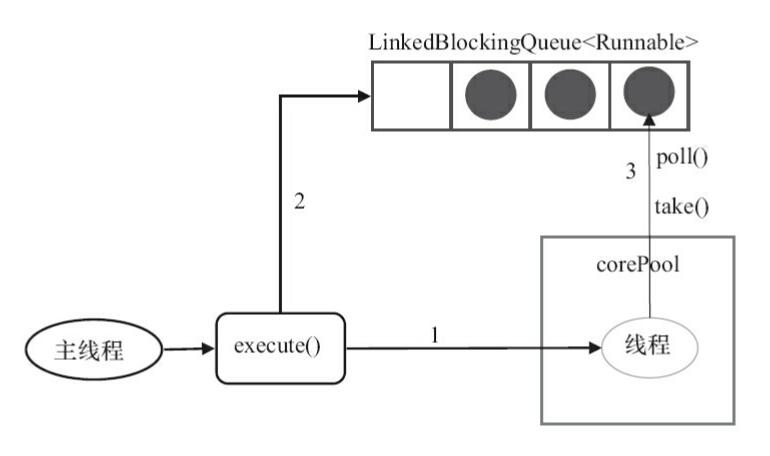
上图说明;
- 如果当前运行的线程数少于 corePoolSize,则创建一个新的线程执行任务;
- 当前线程池中有一个运行的线程后,将任务加入
LinkedBlockingQueue - 线程执行完当前的任务后,会在循环中反复从
LinkedBlockingQueue中获取任务来执行;
2.3 为什么不推荐使用SingleThreadExecutor?
SingleThreadExecutor 使用无界队列 LinkedBlockingQueue 作为线程池的工作队列(队列的容量为 Integer.MAX_VALUE)。SingleThreadExecutor 使用无界队列作为线程池的工作队列会对线程池带来的影响与 FixedThreadPool 相同。说简单点就是可能会导致 OOM(内存溢出)。
3 CachedThreadPool
3.1 介绍
CachedThreadPool是一个会根据需要创建新线程的线程池。下面通过源码来看看 CachedThreadPool 的实现:
java
/**
 * Creates a thread pool that creates new threads as needed, but
 * will reuse previously constructed threads when they are
 * available, and uses the provided
 * ThreadFactory to create new threads when needed.
 * @param threadFactory the factory to use when creating new threads
 * @return the newly created thread pool
 * @throws NullPointerException if threadFactory is null
 */
public static ExecutorService newCachedThreadPool(ThreadFactory threadFactory) {
    return new ThreadPoolExecutor(0, Integer.MAX_VALUE,
                                  60L, TimeUnit.SECONDS,
                                  new SynchronousQueue<Runnable>(),
                                  threadFactory);
}
java
/**
 * Creates a thread pool that creates new threads as needed, but
 * will reuse previously constructed threads when they are
 * available.  These pools will typically improve the performance
 * of programs that execute many short-lived asynchronous tasks.
 * Calls to {@code execute} will reuse previously constructed
 * threads if available. If no existing thread is available, a new
 * thread will be created and added to the pool. Threads that have
 * not been used for sixty seconds are terminated and removed from
 * the cache. Thus, a pool that remains idle for long enough will
 * not consume any resources. Note that pools with similar
 * properties but different details (for example, timeout parameters)
 * may be created using {@link ThreadPoolExecutor} constructors.
 *
 * @return the newly created thread pool
 */
public static ExecutorService newCachedThreadPool() {
    return new ThreadPoolExecutor(0, Integer.MAX_VALUE,
                                  60L, TimeUnit.SECONDS,
                                  new SynchronousQueue<Runnable>());
}
CachedThreadPool 的 corePoolSize 被设置为空(0),maximumPoolSize 被设置为 Integer.MAX.VALUE,即它是无界的,这也就意味着如果主线程提交任务的速度高于 maximumPool 中线程处理任务的速度时,CachedThreadPool 会不断创建新的线程。极端情况下,这样会导致耗尽 cpu 和内存资源。
3.2 执行任务过程介绍
CachedThreadPool 的 execute()方法的执行示意图(该图片来源:《Java 并发编程的艺术》):
示意图「CachedThreadPool的execute()执行示意图」已随上游仓库(DemoTransfer)失效,2026-10 标注%E6%96%B9%E6%B3%95%E6%89%A7%E8%A1%8C%E7%A4%BA%E6%84%8F%E5%9B%BE.png)
上图说明:
- 首先执行
SynchronousQueue.offer(Runnable task)提交任务到任务队列。如果当前maximumPool中有闲线程正在执行SynchronousQueue.poll(keepAliveTime,TimeUnit.NANOSECONDS)。那么主线程执行offer操作与空闲线程执行的poll操作配对成功。主线程把任务交给空闲线程执行,execute()方法执行完成。否则执行下面的步骤 2; - 当初始
maximumPool为空,或其中没有空闲线程时,将没有线程执行SynchronousQueue.poll(keepAliveTime,TimeUnit.NANOSECONDS)。这时步骤 1 将失败。此时CachedThreadPool会创建新线程执行任务,execute方法执行完成;
3.3 为什么不推荐使用CachedThreadPool?
CachedThreadPool允许创建的线程数量为 Integer.MAX_VALUE ,可能会创建大量线程,从而导致 OOM。
4 ScheduledThreadPoolExecutor
ScheduledThreadPoolExecutor 主要用来在给定的延迟后运行任务,或者定期执行任务。 这个在实际项目中基本不会被用到,所以对这部分大家只需要简单了解一下它的思想。关于如何在Spring Boot 中 实现定时任务,可以查看这篇文章<a href="https://github.com/Snailclimb/springboot-guide/blob/master/docs/advanced/SpringBoot-ScheduleTasks.md">《5分钟搞懂如何在Spring Boot中Schedule Tasks》</a>
4.1 简介
ScheduledThreadPoolExecutor 使用的任务队列 DelayQueue 封装了一个 PriorityQueue。PriorityQueue 会对队列中的任务排序。执行所需时间短的放在前面先被执行(ScheduledFutureTask 的 time 变量小的先执行)。如果执行所需时间相同则先提交的任务将被先执行(ScheduledFutureTask 的 squenceNumber 变量小的先执行)。
ScheduledThreadPoolExecutor 和 Timer 的比较:
Timer对系统时钟的变化敏感,ScheduledThreadPoolExecutor不是;Timer只有一个执行线程,因此长时间运行的任务可以延迟其他任务。ScheduledThreadPoolExecutor可以配置任意数量的线程。 此外,如果你想(通过提供ThreadFactory),你可以完全控制创建的线程;- 在
TimerTask中抛出的运行时异常会杀死一个线程,从而导致Timer死机:-( ...即计划任务将不再运行。ScheduledThreadExecutor不仅捕获运行时异常,还允许您在需要时处理它们(通过重写afterExecute方法ThreadPoolExecutor)。抛出异常的任务将被取消,但其他任务将继续运行。
综上,在 JDK1.5 之后,你没有理由再用 Timer 调度任务了。
备注:
Quartz是一个由 java 编写的任务调度库,由OpenSymphony组织开源出来。在实际项目开发中使用Quartz的还是居多,推荐使用Quartz。因为Quartz理论上能够同时对上万个任务调度。它拥有丰富的功能特性,例如任务调度、任务持久化、可集群化、插件。
4.2 运行机制
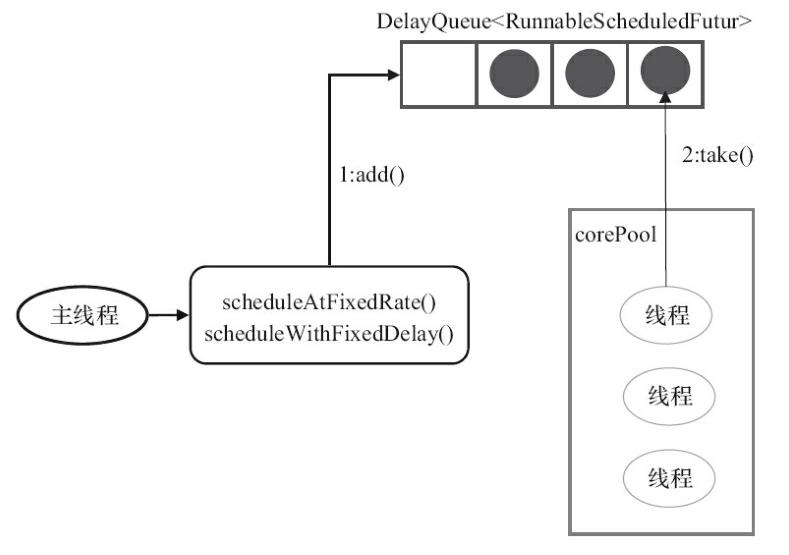
ScheduledThreadPoolExecutor 的执行主要分为两大部分:
- 当调用
ScheduledThreadPoolExecutor的scheduleAtFixedRate()或scheduleWirhFixedDelay()时,系统向DelayQueue添加一个ScheduledFutureTask。这个任务实现了RunnableScheduledFuture接口。 - 线程池中的线程从
DelayQueue中获取ScheduledFutureTask。 - 线程池中的线程执行任务。
ScheduledThreadPoolExecutor 为了实现周期性的执行任务,对 ThreadPoolExecutor 做了如下修改:
- 使用
DelayQueue作为任务队列; - 获取任务的方不同
- 执行周期任务后,增加了额外的处理
4.3 ScheduledThreadPoolExecutor 执行周期任务的步骤
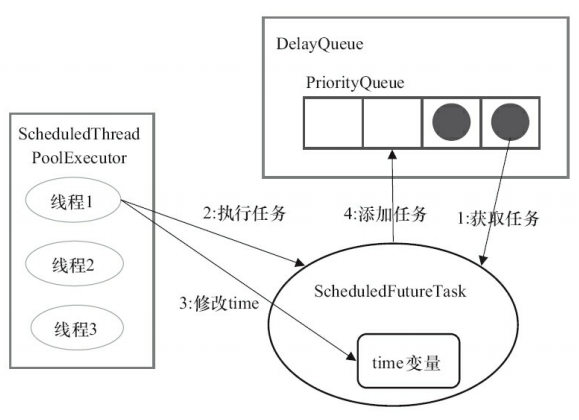
- 线程 1 从
DelayQueue中获取已到期的ScheduledFutureTask(DelayQueue.take())。到期任务是指ScheduledFutureTask的time大于等于当前系统的时间; - 线程 1 执行这个
ScheduledFutureTask; - 线程 1 修改
ScheduledFutureTask的time变量为下次将要被执行的时间; - 线程 1 把这个修改
time之后的ScheduledFutureTask放回DelayQueue中(DelayQueue.add())。